Physical → Digital → On-chain
Built for Everyone.
Engineered for Trust.
Frictionless asset management above. Cryptographic infrastructure below.
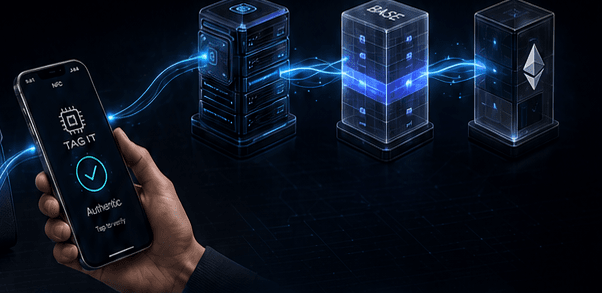
TAG IT binds physical products to on-chain digital twins behind an interface that feels like any other app. No crypto knowledge required to use it — the cryptographic checks still run underneath.
Asset lifecycle
Seven states of verified trust.
Every asset moves through one on-chain state machine, from mint to end of life. Each transition is a contract call and an immutable event.
NONE
Default. The asset does not exist yet.
MINTED
mint()
Digital twin created — no physical tag.
BOUND
bindTag()
NFC tag cryptographically linked.
ACTIVATED
activate()
QA passed — live for consumer scanning.
CLAIMED
claim()
Owned by the end customer.
FLAGGED
flag()
Lost, stolen, or under recall investigation.
RECYCLED
recycle()
End of life — permanently closed.
Forward-only by default. Any claimed asset can be flagged; resolve() returns a flagged asset to its owner. RECYCLED is terminal.
Cryptographic infrastructure
What runs underneath.
Four systems cooperate on every tap: the ORACULS sensing stack, an ERC-8004 agent registry, a signed verification trace, and a contract suite on Base.
ORACULS Stack
Oracle-Augmented Chain for Universal Logistics Security. Five signal classes feed every verification verdict.
- NFC / RFID
- Device Signals
- Vision AI
- IoT & Sensors
- Audit Nodes
ERC-8004 Agents
Six agent services, five registered on-chain, each with a soulbound identity, on-chain reputation, and skills callable with an API key (per-call USDC metering through x402 is designed, not enabled).
- SageRead-only on-chain intelligence
- Verification5-signal NFC verification pipeline
- Anomaly5-detector fraud detection
- RecoveryAIRP loss / theft orchestration
Verification Trace
- MintedTX 0x7a…1fC3Factory AMay 10 · 09:14 UTC
- BoundTX 0x8b…2eA7Tag linkedMay 10 · 09:16 UTC
- ActivatedTX 0x9c…3dB1QA passedMay 10 · 09:17 UTC
- VerifiedTX 0xab…4eD9NFC tapMay 13 · 10:24 UTC
Illustrative trace — every transition is a contract call on Base Sepolia.
Smart Contract Map
Five registries anchored by TAGITCore — deployed and verified on Base Sepolia.
Access modes
Asset management without the friction.
Three ways in — pick the surface that fits. The chain underneath is the same.
Wallet-native
Web3Full compatibility with existing wallets and decentralized protocols. Pro users keep total control of their on-chain assets with the tools they already run.
Email sign-in
No walletSign up and manage physical items with just an email address. The chain stays in the background; the assets stay yours.
Account abstraction
ERC-4337Smart accounts and sponsored gas make it behave like a standard app. Under the hood, every action settles on-chain.
Technical architecture
The ORACULS stack, layer by layer.
Four layers separate everyday UX from final settlement — each replaceable, each verifiable.
01
Applications
User-facing apps and partner integrations: the ORACULAR scanner, the admin console, a B2B partner portal, and SDKs for custom builds.
02
Gateway
Authentication, orchestration, and the agent gateway — four protocol surfaces plus an ECDSA oracle that signs verification results for on-chain use.
03
Execution — Base L2
The contract suite runs verified on Base Sepolia (chainId 84532). Data availability is Ethereum blob space today; EigenDA is a 2028 roadmap item tied to a dedicated L2.
04
Settlement — Ethereum L1
Base settles to Ethereum. Cross-chain attestations over Chainlink CCIP are designed and tested on testnet; production lanes are targeted for H2 2027.
NFC authentication
Tap to verify.
One tap runs an AES challenge–response against the NTAG 424 DNA chip — no app required. The signed result lands on the product's digital twin, verifiable by anyone.
1 tap
To verify
The chip signs a fresh message on every tap and the signature is checked before anything is shown. No app required.
AES-128
Chip authentication
Each NTAG 424 DNA chip holds its own keys (SUN). Unique per chip; never leaves the chip.
Tamper-evident
25 mm label
Removing the tag breaks its antenna. The record keeps the last valid scan.
NFC
Authentic
TAG IT Verified
Digital twins
Every product, uniquely represented.
A digital twin is an ERC-721 token that mirrors one physical product. The pairing is cryptographic, not a database row — the tag proves itself to the token.
Physical
NFC tag
Digital
ERC-721 twin
On-chain data
- Unique token ID
- Current owner address
- Lifecycle state
- Verification count
- Flag / dispute status
Off-chain metadata
- Product specifications
- Manufacturing details
- Images and documents
- Extended attributes
- AI analysis results
Hardware architecture
NFC chip tiers.
From mass-market authentication to high-assurance custody — one ascending tier menu, one crypto floor. Every tier is NXP secure silicon that signs each tap.
- Scale
COMMERCIAL
NTAG 224 DNA
Mass-market authentication for retail, food, and logistics.
AES-128SUNEAL3+ - Floor cost
BUDGET
NTAG 223 DNA
144-byte variant of COMMERCIAL — only when absolute cheapest wins.
AES-128SUNEAL3+ - Premium
PRESTIGE
NTAG 424 DNA
TAG IT standardThe standard chip — 25 mm tamperproof tag for enterprise and high-value assets.
AES-128SUNEAL4 - Enterprise
FORTRESS
MIFARE DESFire EV3
Multi-application zones for pharma, luxury, and finance.
AES multi-appEAL5+ - Defense
SOVEREIGN
NTAG X DNA
True asymmetric crypto with on-chip keys for high-assurance custody.
EAL6+PKI/ECC P-256 - Next-gen
SIGMA BOY
Custom sNFC ASIC
ROADMAP · 2030Post-quantum custom silicon on the 2030 roadmap — not orderable today.
PQCAES-256
SUN is the floor — every tier signs each tap.
Item → Package → Pallet
Item
NFC · per unit
A secure DNA chip from the tier menu on every unit — tap-range, phone-readable, one digital twin per item.
Package
ICODE · HF
13.56 MHz ISO/IEC 15693 labels for case and package identification — inventory reads at 0.3–1.5 m.
Pallet
UCODE RAIN · UHF
860–960 MHz RAIN RFID for bulk dock, gate, and conveyor reads at 10 m and beyond.
One deployment spans item to pallet — both layers resolve the same GS1 Digital Link URL, which keeps the package layer EU Digital Product Passport ready.
Defense in depth
The 5-layer security model.
Concentric layers of protection, from DAO governance at the perimeter to the AES keys sealed inside each chip. A failure in one layer is contained by the layers around it.
- 5
Governance
Multi-house DAO, timelocked execution, and an emergency council with veto powers.
- 4
Application
Rate limiting, schema input validation, TLS 1.3, and WAF / DDoS protection at the edge.
- 3
Access control — BIDGES
Soulbound identity badges plus revocable capability gates — least privilege on every call.
- 2
Smart contract
Checks-Effects-Interactions, reentrancy guards, a pausable circuit breaker, and invariant testing.
- 1
Cryptography
ECDSA signatures, Keccak-256 commitments, and AES-128 + CMAC sealed inside each chip.
- Base block time
- ~2s
- Base block time
- L1 finality (Base)
- 7-day
- L1 finality (Base)
- Chain ID · Base Sepolia
- 84532
- Chain ID · Base Sepolia
- Lifecycle states
- 7
- Lifecycle states
Network figures are Base\u2019s published characteristics; TAG IT runs on Base Sepolia today. Mainnet is audit-gated, targeted H1 2027.
Agent network
Four agents watch the chain.
An ERC-8004 registry gives each agent a soulbound identity, on-chain reputation, and skills callable with an API key (per-call USDC metering through x402 is designed, not enabled). Together they verify scans, detect fraud, and run recoveries.
Agent #1
Sage
Read-only on-chain intelligence
Agent #2
Verification
5-signal NFC verification pipeline
Agent #3
Anomaly
5-detector fraud detection
Agent #4
Recovery
AIRP loss / theft orchestration
Ready to integrate?
Read the documentation, query the contracts on Base Sepolia, or talk to the team about your deployment.