Ask
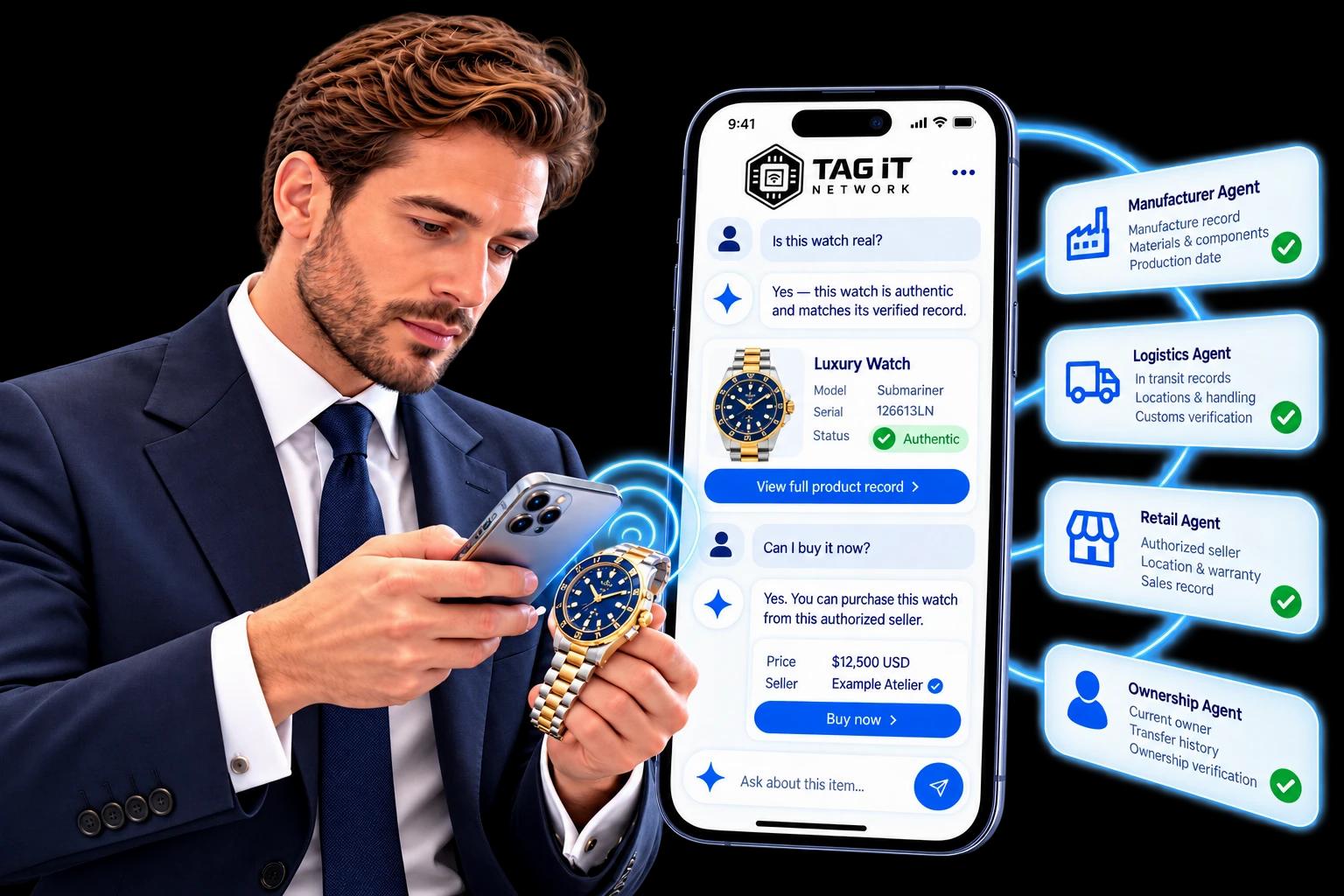
Is it real? Who owns it? How much is it? How do I look after it? Every answer comes from the item's record.
AI agents
Two kinds. An agent for the people who buy and own products, which meets them wherever they already are, and a network of agents for the businesses that make, sell and move them. All of them read the same verified record and act only within the permissions you set.

Part one · For your customers
Every tagged product gets its own agent. Your customer taps the product and talks to it: in your app, on the web page the tap opens, or in the assistant they already use. No new app to install.
Is it real? Who owns it? How much is it? How do I look after it? Every answer comes from the item's record.
If the item is for sale, the same tap starts the purchase. The moment it is paid for, the record says it is theirs.
Proof of ownership lives on the record. Passing the item on is one signed action, with no paperwork.
Flag it lost or stolen, raise a warranty case with the history attached, or retire it at end of life.
Live in the TAG IT app · Embeds in your app through the SDK
In-app embedding is scoped per pilot with your team.
Part two · For your business
TAG IT runs agents the way a company runs departments: one checks every scan, one watches for anomalies, one handles recovery, one tracks shipments, and so on. Each has a public identity on the network, a defined set of skills, and permissions it cannot exceed. Not all of them are deployed yet, and the labels below say which are.
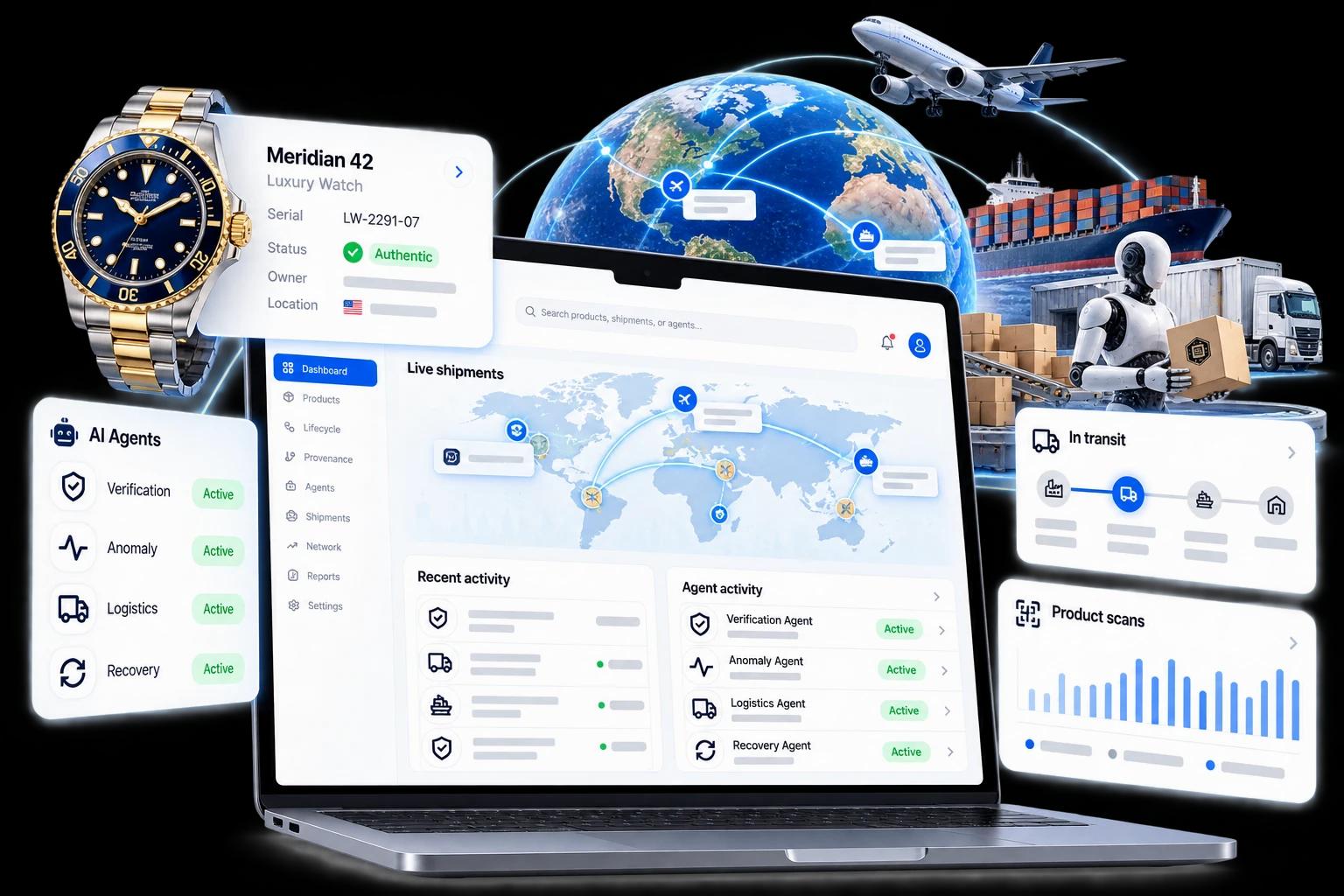
On the network now, with a public identity each.
Checks every tap and every lifecycle step against the tag and the record. It cannot be bypassed.
Answers product and price questions for other AIs and assistants, including as MCP tools.
Watches scan patterns for replays, odd speed, odd places and counter jumps, and raises a signal.
Opens a case for a flagged item, scores the risk, and runs the resolution round.
The rule keeper. Validates every lifecycle transition and holds the binding between tag and record.
The front door for agents: identity, reputation and validation lookups, free to read.
Built and running for pilots, with their scope still widening.
Tracks shipments through the UPS API today. Custody by tap at pickup and delivery, and bidding on shipments, come next.
The only agent that grants, changes or revokes capabilities, and it watches how every other agent behaves.
Settlement and escrow for deals, in USDC today.
Keeps the canonical record of what a product should look like and publishes the brand's attestations.
Legal holds, quarantine and dispute decisions on on-chain evidence.
Batch minting, chip binding at the station, and provenance from day one.
Listings, pricing, activation and settlement to the buyer's wallet.
End-of-life routing, component recovery and the item's final recycled state.
Designed in the whitepaper, not yet built. Pilots decide which come first.
Screens counterparties and components against sanctions and export-control lists before a deal or a custody move.
Finds every affected item from a component batch in seconds, notifies owners and tracks returns.
Registers the warranty on claim and checks each claim against the service log.
Custody and scan history as evidence for policies and claims.
Cross-border paperwork generated from provenance data.
A carbon ledger per item, built from supplier declarations and logistics legs.
Statuses match the TAG IT agent directory on 2026-10-30. The whitepaper also describes warehouse, routing, procurement, inventory, quality and scheduling agents for manufacturing operations; those follow the pilots that need them.
Any model
TAG IT is not tied to one model. Through MCP and a plain API, any AI can read a product's record: the assistant your customers already talk to, or the model your own team runs. A public read-only MCP lets any assistant verify an item, read its history and check whether it is flagged, with no account at all.
What any assistant can ask
The three public tools. Twelve more run behind an API key.
Build your own
Verification, product data, anomaly checks, recovery, logistics, or a job of your own. Skills are the building blocks.
Your agent is registered on the network with its own identity, so every action it takes is signed and accountable.
It acts only within what you allow, and the contract checks that on every action, not the model.
Custom agents are scoped per pilot. The first ones are built with us.
Built to be trusted
The Ask assistant runs inside the TAG IT app, served from AWS with a Claude model. Verification and record workflows are live on our test network. Checked 2026-10-26.